Showing posts with label SEO-Tips. Show all posts

Tuesday, January 24, 2012

How to build a Perfectly optimized page? - SEO


Google Ranking Algorithm


How to build a Perfectly optimized page?- SEO

If you are referencing, you've probably heard this question a lot. Yes, there is no clear answer for this question, but there are sets of some best practices where we can learn from and sharper to help get around. In this article I will share some of the best recommendations for the successful on the page keyword targeting "perfection".After reading the entire article you will not ask any one or you will not question yourself "How to build a fully optimized page?"

Look at the image below, it shows the clear idea about How to build a Perfectly optimized page?


Now i will explain Some of the important HTML tags useful for SEO to build Perfectly optimized page based on Google Ranking Algorithm

* Title Tag - The main page is a key element of the word, the page title should preferably use the term word / phrase as the first word (s). Our correlation studies, It 'clear, using the term word / phrase as the very first words in the page title is the highest correlation with the placement, and subsequent almost perfectly correlated to lower ranking.

* Meta Description Tag - Every time Google and so many websites keep on saying Meta description tag is not a ranking factor for SEO, But what i suggest is to use Meta Description tag. The reason for using this meta description tags is, it tells the user whether he can click on the link or not in search results, means meta description tag tells the user that whether the page is relevant to his search term or not. this means it is a factor for relevancy.

* Meta Keywords - Google Ranking Algorithm stopped ranking for Meta Keywords Tag long back and hope it will never come back for using Meta keywords tag.Google found that so many websites trying to use irrelevant keywords in meta keywords tag to capture more visits.When Google found this, with in few days Google changed its algorithm by not considering the meta keywords tag.
But now yahoo is the single search engine for considering the meta keywords for rankings and Microsoft Bing set to take over Yahoo! Search, last September to take on tag is now gone.

* Meta robots - although it is not necessary, it should take, be sure not to include such guidelines as may prevent access by search engines.

* Rel = "canonical" - the largest and most complex of a website, the more  Google Ranking Algorithm  recommend that you use the canonical URL tag to avoid duplication or unintentionally, the URL attached strings to create a problem for engines and link juice fragmentation potential.

* Other Meta Tags - Meta tags such as those offered by the FGDC and DCMI is convincing, but does not currently provide any benefit for SEO in the big engines and add unnecessary complexity and download time.

SEO Tips when writing URL's or Search engine Friendly URL's:

* Short URL looks better in search results and also dont forget to include your most targeted keyword in the URL.

* Hyperlinks are still most important to separate words(ABC.com/buy-books-online.asp is much better than ABC.com/buybooksonline.asp). But Remember that this should be good for SUb domains not for root domains.

Content Optimization for SEO(Web page Optimization):


* Number of repetitions of key words - According to Google Ranking Algorithm ,there is no Exact optimal number of times to use a key word  on the page but i suggest  - "2-3X short sides, 4-6X the longest, and never more sense for the copy. 


* Keyword Density - This is the important this you need to consider when you are doing ON Page Optimization, But the question is  what is the good keyword density?.
The Good Keyword Density for Google is 2.0 to 2.5%
The Good Keyword Density for Yahoo is is 3 to 5%
The Good Keyword Density for Bing is also 3 to 5%.
If you are using more above 3% Google may consider as spam, I would suggest you to use 2.0 to 2.5% as the The Good Keyword Density for Google is 2.0 to 2.5%, it is not a spam but you will get rankings in Yahoo and bing also but it may take some more time comparing to Google rankings.


Links to other Pages(internal Linking):
it is the right time to ignore the links to other pages using images or graphics, it will not help you in any way.Use internal linking with images if necessary, even if you are using image links i suggest you to use text links also at-least use footer for this.When you are using text links use the most relevant keyword of the going page as a anchor text, this technique help a lot to get organic rankings, "click here" will not work for you.


H1 Tag for Better Search Engine Rankings:
As H1 tag tells the user about "what the whole page is about?", it is very important to use H1 tag at top of the page.If you are trying to use your most targeted keyword in the begging of the H1 tag definitely it will help for better rankings in Search Engines.


Other Header tags(H2,H3..H6): Acording to Google Ranking Algorithm Even smaller than the H1, my recommendation is that they apply only if necessary. 


Alt Tags: After the Panda Update  So many Search engine Optimization Guru's using Alt tags, Panda Update is a lesson for all who are not using alt tags before the panda.So here i strongly recommend to use the ALT Tags.
Other Tips: Use the different fonts when it is required Ex: Bold, italic, etc..


Finally you may ask me why i should follow what you are writing in your blog, you are right here is the proof from Components of Google Ranking Algorithm by SEOMoz.


Image: How Google Ranking Algorithm Works?

Please add your comment here if i am giving any information which is not true.Thanks for visiting my Blog More Traffic with SEO submitted by Veerender


Monday, January 2, 2012

12 SEO Tips to Gain Good Rankings in Search Engines Using Dreamweaver - SEO and Dreamweaver

12 SEO Tips to Gain Good Rankings in Search  Engines Using Dreamweaver - SEO and Dreamweaver

That means doing things like adding alternative text behind your images and using the Meta description tag. In this tutorial, you’ll find a few SEO Tips and discover the features in Dreamweaver that will best serve your SEO efforts.

If you are looking to make your website more search engine friendly, the best way that you can do is " Design your website in such a way that Search Engines read all of your pages". I know this is easy to tell but difficult to do, Doing some things like adding alternative text behind your images and using the Meta description tag.
Here you will find few Best SEO Tips to Gain Good Rankings in Search  Engines Using Dreamweaver and discover the different features that are available in Dreamweaver that will boost your SEO efforts and of-course Search engine Rankings.

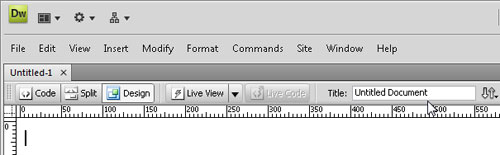
1. Never leave a web page with out a title or only with your brand name
When you are creating a new page, Keep in mind that Dreamweaver automatically adds the words “Untitled Document” for every page, but you Don't leave it as “Untitled Document”  . Even though the title you are using doesn’t appear in the body of your Web page, title tag highly valued by all major search engines (so be sure to include your best keywords). Title text will appears in the very top of the browser window, and it’s the text that gets saved when someone bookmarks your site, try to show the most relevant content from your page as a title. It’s very easy to change a title in Dreamweaver, just click in the Title field at the top of the workspace and type your new title. It heps a lot to get good Search engine Rankings.
Never leave a page untitled

2. Use Alt text for image tags

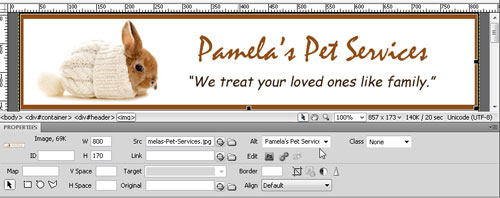
Alt text is the The HTML image attribute for Alternative Text for Images, commonly abbreviated as Alt text, lets you include a text description with all your your images. The spiders and bots that search engines use to crawl any website’s content, They  can’t see words or sentences that one has  saved in an image, but they can read Alt text in the code assisted with <img>, So it is good to use alt text along with your image tags. There are two ways to add alt text for images

1. When you are inserting an image to a page, Dreamweaver prompts you to add Alt Text in the Image Tag Accessibility Attributes dialog. 

2. You can add Alt Text by clicking to select any image and then entering text in the Alt field in the Property inspector.


Use Alt text behind images
— Cute bunny picture from iStockphoto, by Ekaterina Monakhova

3. Add unique meta descriptions to all pages using the Meta Description tag

The Meta Description tag will come in the Head area at the very top of your HTML code for your web pages. Humans cannot see this Meta Description tag, because  Meta Description   tag will not displayed in a web page, but Meta Descriptions tags are often used in Search Engine Results and they can make a big difference in whether someone clicks on your site or not, Try to add the keywords that you are targetting in your Meta Description tags so that when it is showed in search Results a searcher may feel that your website is going to give the exact information that what they are looking for. Search engines will show the meta description tag 250 to 260 characters only so write your Meta Description not more that 260 characters.
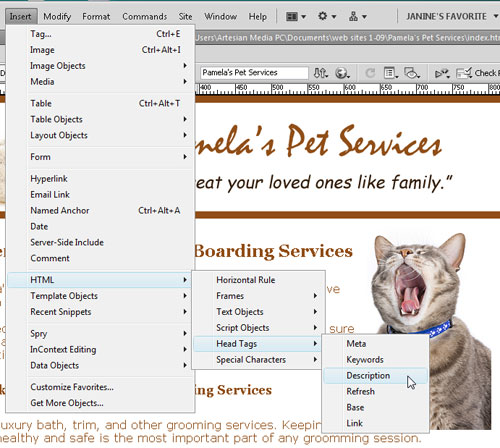
To add  Meta Description in Dreamweaver, choose Insert > HTML > Head Tags > Description and then type a description. You can add different descriptions to any or all of the pages in your site.
Add unique descriptions to every page using the Meta Descriptions tag
— Yawning cat from iStockphoto by Jose Elias

4. Include Targeted Keywords with the Meta Keywords tag

Many SEO guru's will says that adding keywords under Meta keywords tag will boost your rankings highly, but Many search engines ignore the text in the Meta Keyword tag because it’s been so badly abused by web designers by  trying to trick search engines with unrelated terms, but I can say that adding keywords under meta tags can’t hurt your pages (as long as they match the content), and it’s good to include your most important keywords on every page which are related to webpage content. When you are adding the keywords under  Meta Description tag, it’s easy to throw in a few keywords with the Meta Keyword tag. 

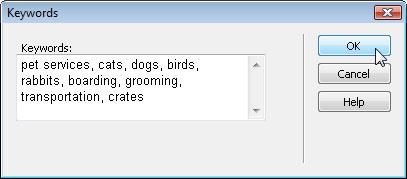
Include Targeted Keywords from the same menu in Dreamweaver, just choose Insert > HTML > Head Tags > Key Words. 

Include Keywords with the Meta tag

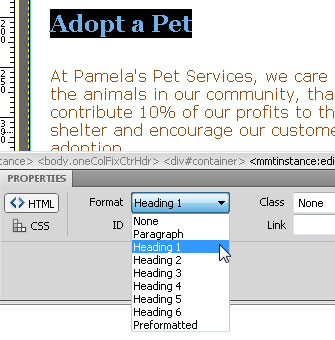
5. Use Heading Tags to the pages

Heading tags are the HTML tags starting with H1 through H6, Heading are designed to format headlines with graduated levels of big and  bold text. Although there are so many ways to style the text but  heading tags are considered especially valuable by Search Engines because they help to  identify the importance of information off the page, Which means that Heading tags tell the users that the whole information in that page is all about the content included in heading tag. Format your most important headline with the H1 tag, less important text, in the H2 tag, and so on. try to include your targeted keywords in your header tags , But there is no guarantee that adding keywords in header tags  will improve your rankings, but it’s believed that the text included in heading tags gets some special attention from search engines.

Use Heading Tags to Show Hierarchy

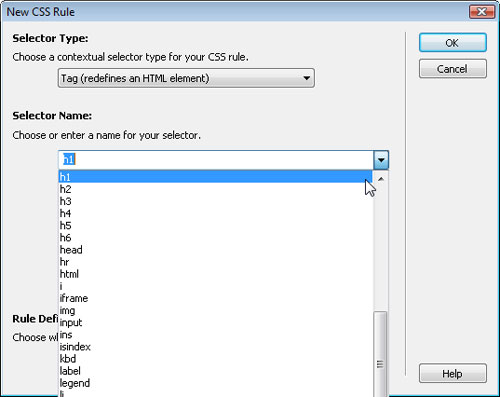
6. Change the Appearance of Heading Tags with CSS

And now, You can change the appearance of your heading tags if want and if you fell your heading tag is not looks good with bold or times roman formatting. You can do this By creating New CSS Rules using the Tag selector. you can change the font, color, size, and other formatting options of any or all of the H1 through H6 heading tags. To do so, create a new style, choose the Tag selector, and then select any heading tag from the HTML drop-down list.
Change the Appearance of Heading Tags with CSS

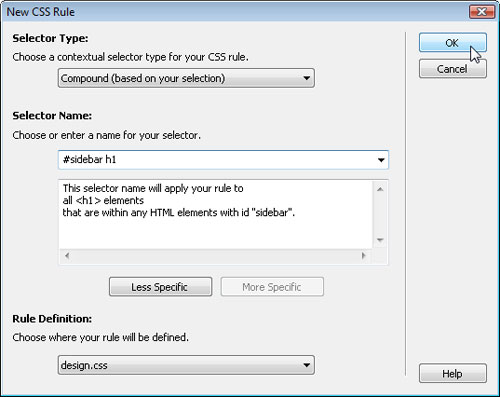
7. Control the Appearance of Heading Tags as you want

If you are looking to Control the Appearance of Heading Tags you can use the Compound Styles to do that.You can create different different styles for the same heading tags using compound styles. 
Use Compound Styles to Control the Appearance of Heading Tags


8. Build back links to your site from Relevant and Quality sites

Many Search Engines links to website as a vote of confidence especially the Google , but it is not just the link from other sites but the text in the link tag. If the link to your site includes the keyword that you are targeting, it can improve your ranking for that keyword.
For example, if i want to link to a site www.emailmarket.com who provides email marketing services, instead of giving with click here to visit emailmarket.com. It is good for the site if the links goes with click here to vist email marketing service.
Now a days most of SEO's says that the backlinks will not give rankings to the websites, i strongly disagree with them, the reason is look at the example...... 
For example, if you type "login" in Google search, Observe that Facebook and Gmail will occupy the first two places, the reason is there are so many in that the world that are linking to the facebook and Gmail with the word "login". 


Invite the best sites to link to you

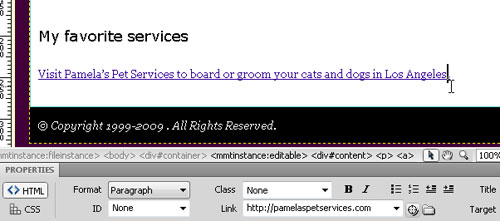
9. Internal links are Much better to get Good Rankings

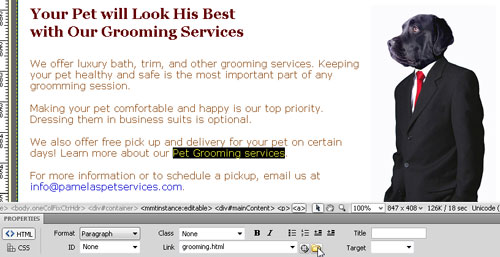
As i mentioned earlier in "Build back links to your site from Relevant and Quality sites" all major search engines give high priority for the keywords that appear in link text, that might be from other websites but also s a link on your own web site. When you are giving link from one page in your site to another page in your site, use keywords that are relevant to the link going page content, instead of the general word “click here.” 

Make the most of internal links
— Dog in a suit from iStockphoto by Diane Diederich

10. Use keywords in navigation links

The more number of times the keywords are linked to the same page with single keyword, Search Engines gives more for that keywords .
One key point to success in search engine is to pay a special attention when you are creating navigation links from one page to another for the the most important and relevant pages of your site. Make sure to include the keywords in the anchor texts and use text for the links not images. If it is necessary for you to add graphical images to link to other page, make sure that you are linking to the same page with a   text link also for each page at the bottom of the pages.
Use keywords in navigation links

11. Use templates to make it easy to use key elements throughout your site

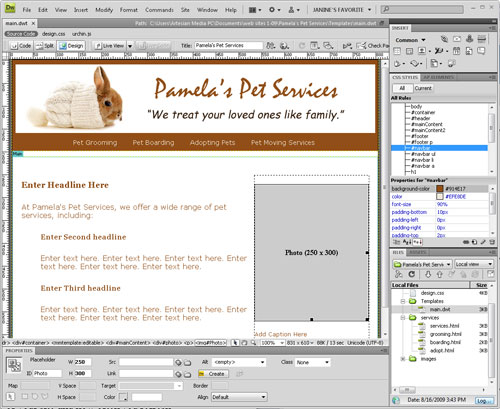
When you are creating a web site in Dreamweaver, Dreamweaver’s web templates will make it easy to repeat the key elements and you can update also, such as navigation bars, and the Alt text with images and  banners. Anyone can create templates in Dreamweaver by saving any page as a .dwt file and then created and update the rest of the pages in your site using that template.

Use templates

12. Make your site SEO friendly from the beginning

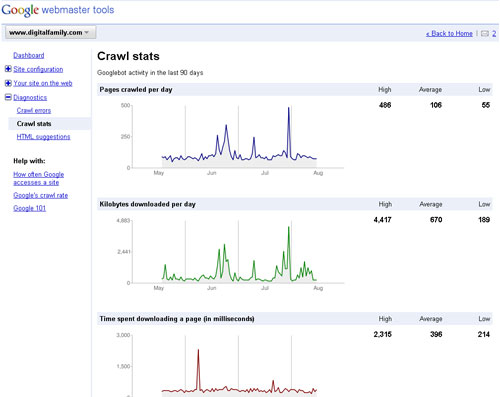
Considering the best options for SEO from the start is best, but if you’ve already built your site, you can always go back and make adjustments. Most search engines, such as Google, visit web sites regularly. If you’re not familiar with Google’s webmaster tools, the many reports, charts and graphics on this page make it a great place to learn more about how your site ranks and how to make it better.
Google's Webmaster Tools


Follow my blog if you like this post, I will be updating more SEO Tips and SEO news regularly.

Sunday, January 1, 2012

How Google Works


How Google Works?


Google runs on a distributed network of millions of of computers and can therefore carry out fast parallel processing. 

Parallel processing is a method of computation in which many calculations can be performed simultaneously, significantly speeding up data processing. Google has three distinct parts:

1.The Googlebot
2.The indexer
3.The query processor

Let’s take a closer look at each part.

1. Googlebot, Google’s Web Crawler - How Google Works?

Googlebot is Google’s web crawling robot, which finds and retrieves pages on the web and hands them off to the Google indexer. It’s easy to imagine Googlebot as a little spider scurrying across the strands of cyberspace, but in reality Googlebot doesn’t traverse the web at all. It functions much like your web browser, by sending a request to a web server for a web page, downloading the entire page, then handing it off to Google’s indexer.
Googlebot consists of many computers requesting and fetching pages much more quickly than you can with your web browser. In fact, Googlebot can request thousands of different pages simultaneously. To avoid overwhelming web servers, or crowding out requests from human users, Googlebot deliberately makes requests of each individual web server more slowly than it’s capable of doing.
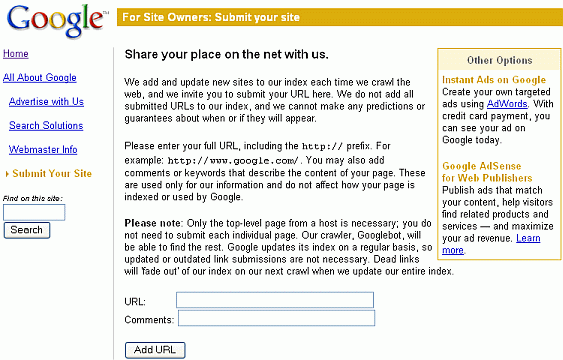
Googlebot finds pages in two ways: through an add URL form, www.google.com/addurl.html, and through finding links by crawling the web.


More Traffic with SEO- GoogleBot


Unfortunately, spammers figured out how to create automated bots that bombarded the add URL form with millions of URLs pointing to commercial propaganda. Google rejects those URLs submitted through its Add URL form that it suspects are trying to deceive users by employing tactics such as including hidden text or links on a page, stuffing a page with irrelevant words, cloaking (aka bait and switch), using sneaky redirects, creating doorways, domains, or sub-domains with substantially similar content, sending automated queries to Google, and linking to bad neighbors. So now the Add URL form also has a test: it displays some squiggly letters designed to fool automated “letter-guessers”; it asks you to enter the letters you see — something like an eye-chart test to stop spambots.
When Googlebot fetches a page, it culls all the links appearing on the page and adds them to a queue for subsequent crawling. Googlebot tends to encounter little spam because most web authors link only to what they believe are high-quality pages. By harvesting links from every page it encounters, Googlebot can quickly build a list of links that can cover broad reaches of the web. This technique, known as deep crawling, also allows Googlebot to probe deep within individual sites. Because of their massive scale, deep crawls can reach almost every page in the web. Because the web is vast, this can take some time, so some pages may be crawled only once a month.
Although its function is simple, Googlebot must be programmed to handle several challenges. First, since Googlebot sends out simultaneous requests for thousands of pages, the queue of “visit soon” URLs must be constantly examined and compared with URLs already in Google’s index. Duplicates in the queue must be eliminated to prevent Googlebot from fetching the same page again. Googlebot must determine how often to revisit a page. On the one hand, it’s a waste of resources to re-index an unchanged page. On the other hand, Google wants to re-index changed pages to deliver up-to-date results.
To keep the index current, Google continuously recrawls popular frequently changing web pages at a rate roughly proportional to how often the pages change. Such crawls keep an index current and are known as fresh crawls. Newspaper pages are downloaded daily, pages with stock quotes are downloaded much more frequently. Of course, fresh crawls return fewer pages than the deep crawl. The combination of the two types of crawls allows Google to both make efficient use of its resources and keep its index reasonably current.

2. Google’s Indexer - How Google Works?

Googlebot gives the indexer the full text of the pages it finds. These pages are stored in Google’s index database. This index is sorted alphabetically by search term, with each index entry storing a list of documents in which the term appears and the location within the text where it occurs. This data structure allows rapid access to documents that contain user query terms.
To improve search performance, Google ignores (doesn’t index) common words called stop words (such as theisonorofhowwhy, as well as certain single digits and single letters). Stop words are so common that they do little to narrow a search, and therefore they can safely be discarded. The indexer also ignores some punctuation and multiple spaces, as well as converting all letters to lowercase, to improve Google’s performance.

3. Google’s Query Processor - How Google Works?

The query processor has several parts, including the user interface (search box), the “engine” that evaluates queries and matches them to relevant documents, and the results formatter.
PageRank is Google’s system for ranking web pages. A page with a higher PageRank is deemed more important and is more likely to be listed above a page with a lower PageRank.
Google considers over a hundred factors in computing a PageRank and determining which documents are most relevant to a query, including the popularity of the page, the position and size of the search terms within the page, and the proximity of the search terms to one another on the page. A patent application discusses other factors that Google considers when ranking a page. Visit SEOmoz.org’s report for an interpretation of the concepts and the practical applications contained in Google’s patent application.
Google also applies machine-learning techniques to improve its performance automatically by learning relationships and associations within the stored data. For example, the spelling-correcting system uses such techniques to figure out likely alternative spellings. Google closely guards the formulas it uses to calculate relevance; they’re tweaked to improve quality and performance, and to outwit the latest devious techniques used by spammers.
Indexing the full text of the web allows Google to go beyond simply matching single search terms. Google gives more priority to pages that have search terms near each other and in the same order as the query. Google can also match multi-word phrases and sentences. Since Google indexes HTML code in addition to the text on the page, users can restrict searches on the basis of where query words appear, e.g., in the title, in the URL, in the body, and in links to the page, options offered by Google’s Advanced Search Form and Using Search Operators (Advanced Operators).
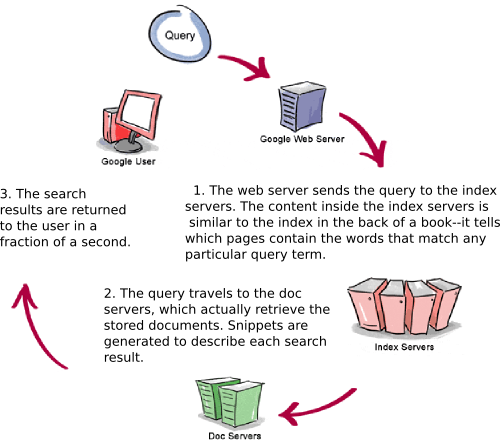
Let’s see how Google processes a query.
 More Traffic with seo
Google’s Query Processor
.
For more information on how Google works, take a look at the following articles.
If you like this article follow my blog to get Regular Google Updates and Search Algorithms.

How Google Works? Posted by Veerender

Source: http://www.googleguide.com

Wednesday, February 9, 2011

What is the importance of the Meta Description tag for Search Engine Optimization

What is the importance of the Meta Description tag for Search Engine Optimization?


This is a very frequently asked question by many SEO’s and Webmasters  all around the world.I am sharing my experience to give you some idea about Using Meta Description tags in your website.

Now days the importance of the meta description is very less and it has less impact on Search Engine Results. The importance of Meta Description tag was an important factor for a higher position in Search Engines Result Pages on the beginning of Search Engines.

But Now search engines are more wider and if you are spamming  meta description might can bring your site to get penalized or even banned in Search Results. Once you are banned means It is very difficult  to recover your website from a ban.

Be aware, if you decide to use meta descriptions for your pages don’t allow them to look spammy and don`t stuff the them whit lots of keywords.

You would need to write a relevant meta description based on your content, then Google may use meta description as a snippet for search results description .

Keep in mind that, a well written Meta description can attract more visitors through search engines search results, but make sure that you are creating a separate Meta description for each and every page on your website.

Take the help of Google Webmaster tolls to identify easily for any Duplicate title and Meta description tags if you are handing the project which is optimized by some other before you. Because most of the search engine consider Meta description as a website content. If you use same one on more than one pages it comes under spam.

If you decided to use Meta description for your project or your website, try to keep your description tag between 150 to 170 characters, make sure you are not repeating any keyword more than twice to maintain good keyword density. Write the effective, unique and relevant Meta description each and every particular page; write them for humans instead of search engines.


Now it is up to you whether to use Meta Descriptions in your Website or not.
Good Luck..
  • Popular
  • Categories
  • Archives